Table of Contents
We're at an inflection point in industrial automation. Robots are getting smarter, faster, and cheaper, but the hardest problems in robotics aren't necessarily hardware related. They're about judgment. And that's exactly where remote teleoperation comes in.
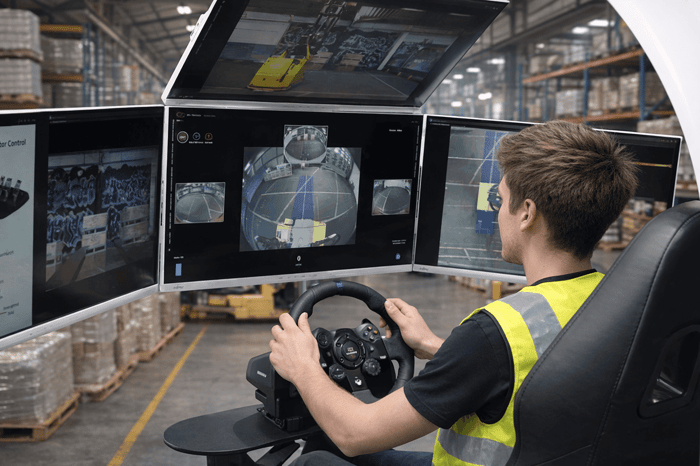
Remote teleoperation is the ability for a human operator to control a robot or machine from a distance in real time and it isn't a stopgap until full autonomy arrives. It's a core capability that makes industrial automation deployable today, at scale, in environments that are too complex, too dangerous, or too unpredictable for fully autonomous systems.
The Industrial Case
 Remote teleoperation reduces the need to place skilled workers in hazardous environments, chemical plants, offshore rigs, nuclear facilities, underground mines. It allows one expert operator to supervise and intervene across multiple machines simultaneously, increasing utilisation and reducing labour costs without sacrificing safety or quality.
But the deeper value is operational resilience. This means that when an autonomous robot hits a scenario it hasn't been trained on, a human can step in within seconds, not hours. That fallback capability is what makes industrial customers willing to deploy automation at all.
Companies like Phantom, Sarcos, and Hex have built entire product lines around this insight. The most forward-thinking manufacturers aren't choosing between humans and robots. They're building systems where remote teleoperation is the connective tissue between the two.
The Path to Autonomy
Here's what most people miss: remote teleoperation isn't the opposite of autonomy, it's the fastest path to it.
Every time a human operator is used to navigate a tricky scenario, that interaction generates training data. The robot learns from the human. Over time, the scenarios that require human intervention get narrower and narrower. The system becomes more autonomous precisely because it captured the edge cases that no simulation ever would.
This is the same logic behind reinforcement learning from human feedback. You don't get to autonomy by trying to build it from scratch. You get there by building tight feedback loops between human expertise and machine learning, and remote teleoperation is one of the most powerful feedback loops in industrial robotics.
The Challenges Are Real and Solvable
Cybersecurity is a genuine concern: a remotely operated system is a remotely hackable system if not properly secured. Network reliability in certain environments, underground, remote offshore, legacy facilities, remains a challenge. And operator fatigue is a real variable; maintaining precision control over long shifts requires thoughtful UX design and operator rotation protocols.
None of these are fundamental blockers. They're engineering problems, and they're being solved. The companies winning right now are the ones treating it as a systems problem, not just a hardware or software problem in isolation.
What Comes Next
The next five years will see remote teleoperation become a standard layer in industrial automation stacks, not a novelty, not a workaround, but an expected capability. As digital twin technology matures, operators will increasingly work in hybrid environments: part physical feed, part simulated overlay, with AI flagging anomalies and suggesting interventions in real time.
The organisations that invest in the infrastructure now will have a significant advantage. They'll have the data, the workflows, and the operator expertise that can't be replicated quickly. In automation, that kind of institutional knowledge compounds.
Remote teleoperation is one of those technologies that looks like a bridge but turns out to be a destination in its own right. The smartest teams in industrial robotics already know this. And Adamo is here to serve them.