Table of Contents
What is it?
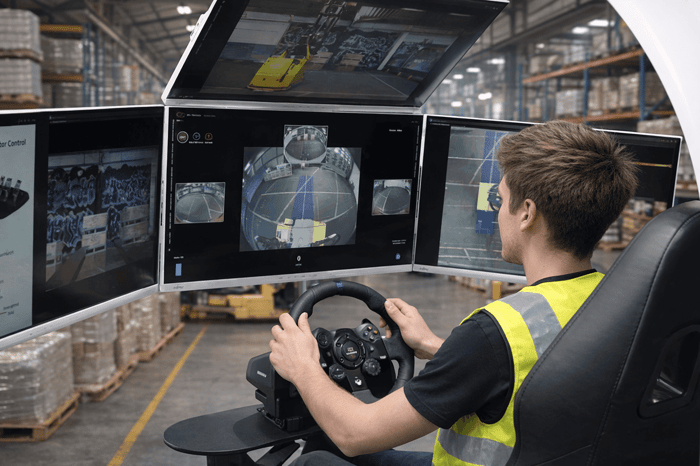
At its simplest, teleoperation is the ability to control a physical entity from a long distance. Separating the word into two parts: 'tele' means at a long distance, and "operation" means control. Put them together, and you have the ability to operate a machine or robot from distance.
Think of it like the world’s most advanced video game. You control a real robot or vehicle instead of a character on a screen. This robot can be in a hospital, at the bottom of the ocean, or even on another planet.
How It Works: The Two-Way Street
Teleoperation isn't just about sending a signal; it’s a constant conversation between a human and a machine. It relies on three main ingredients:
The Operator: A human making the big decisions
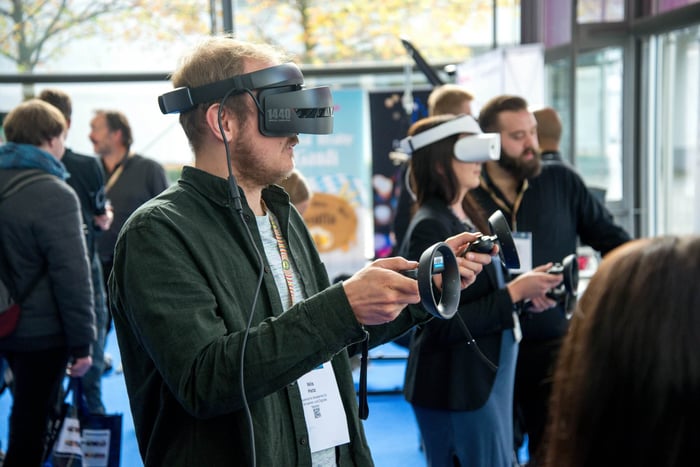
The Commands: Your inputs (joysticks, buttons, or hand gestures) sent over a network
The Feedback: The operator must see what the robot sees. They should also feel what it feels. You can achieve this through video feeds, sensors, or haptic feedback like vibrations or resistance.
Why Do We Need It?
While AI is getting smarter, humans are still the champions of "common sense" and adapting to the unexpected. Teleoperation is our best tool for situations that are:
Dangerous: Like defusing a bomb or cleaning up a chemical spill
Unreachable: Like repairing a satellite in orbit
Complex: Like a surgeon performing a delicate procedure from a different city
The Challenge: Staying 'In Sync'
Since teleoperation occurs over a network, the main challenge is latency. This is the "lag" you may feel during a Zoom call. For a robot to be helpful, the delay between the human's move and the robot's action must be very small. Engineers work tirelessly on "robust systems" to make sure that even if the Wi-Fi drops, the robot stays safe and steady.
Teleoperate with Adamo
Adamo serves as the primary mission control interface for remote robotic operations. Adamo helps engineering teams connect raw data to human understanding. This allows them to control assets in complex or dangerous environments. Remote commands are supported by a fast and detailed data stream.
Optimized Custom Protocol vs. Standard WebRTC
WebRTC is popular for video in browsers. However, it often gives up data integrity and synchronization for smoother playback. Adamo’s custom protocol is engineered to bypass these limitations:
Frame-Accurate Metadata: We embed robot state data (transforms, joint positions, and IMU data) directly within the custom transport stream. This eliminates "drift" where the video feed and the sensor data fall out of sync
Efficient Data Capture: By using a custom stack, Adamo captures high-bandwidth telemetry and raw video more effectively, reducing the CPU overhead on the robot’s onboard computer compared to heavy WebRTC encoding
Adaptive Bitrate for Robotics: Our protocol prioritizes critical control packets and sensor updates even when network conditions degrade, ensuring the operator never loses "the feel" of the robot
Strategic Operational Value
By deploying Adamo as your teleoperation backbone, you solve the "information overload" and "lag" problems often faced by remote pilots:
Unified Situational Awareness: Rather than switching between terminal windows and video players, Adamo consolidates multi-modal sensor data into a single, time-aligned dashboard using our high-efficiency data pipeline
Predictive Diagnostics: With timeline-based playback, teams can instantly "rewind" a teleoperation session. Because our protocol captures data more effectively, you get a higher-fidelity reconstruction of the event for debugging
Customizable Command Centers: The UI can be architected for specific mission profiles, whether that involves precision manipulation of a 7-DoF robotic arm or long-range navigation of an autonomous ground vehicle (AGV)
Operational Scalability: Adamo's optimized protocol allows for remote intervention over lower-bandwidth links where standard video streaming would typically fail or stutter
Want to start building robust teleoperation systems? Explore Adamo's services and software to power your robotics deployment
FAQs
Where is teleoperation used most today?
Teleoperation is largely used for autonomous vehicles and humanoids, across several key industries including:
Healthcare: Robotic-assisted surgery (e.g., the Da Vinci system)
Mining & Construction: Operating heavy machinery in dangerous or toxic environments from a comfortable office
Subsea: Remotely Operated Vehicles (ROVs) repairing underwater cables or oil rigs
Logistics: Remote pilots taking over autonomous delivery bots when they get stuck on a sidewalk
Can Adamo help us source and manage teleoperators?
Absolutely. As well as teleoperation software, Adamo provides a full hiring infrastructure. We take care of the recruitment, training, and management of remote teleoperators, allowing you to scale your robot fleet without the overhead of managing a massive remote workforce yourself
Can teleoperation be done over 5G?
Yes, 5G is a game-changer for this field. Unlike 4G, 5G offers ultra0reliable low latency communication (URLLC). This allows for high-definition video feeds and real-time control signals to travel with minimal delay, making remote operation of excavators or delivery droids much smoother over cellular networks