How safety critical robot fleets should weigh building their own operator pool against buying robot teleoperation services.
Most robotics companies hit a moment where robot teleoperation stops being a research project and becomes an operation. It usually arrives the quarter after the first fleet pilot, when the engineering team realises a robot at a customer site needs someone to recover it at 2am on a Saturday, and that someone has to be hired, trained, badged into a secure room, paid, scheduled, and replaced when they quit. Suddenly the question on the Slack thread is not about codecs or controllers. It is about headcount.
That is the moment robotics leaders make a structural choice that compounds for years: build the operator capability in house, or buy robot teleoperation services from a provider that already runs one. The decision frames everything downstream, from hiring plans and facility leases to incident response, training data pipelines, and the integration work the engineering team owns for the rest of the decade.
This post walks the tradeoff for safety critical fleets in 2026. Humanoids in warehouses, AMRs on factory floors, robot arms at industrial cells, last mile delivery rovers on sidewalks. Pick any of them and the operations question lands in the same place, and it is hitting harder in 2026 than it did last year. Adamo runs both the robot teleoperation platform and the managed operator network, so this call lands in our inbox most weeks.
The 2026 backdrop
Two things changed in the last 18 months that move this from a strategy question to an urgent one.
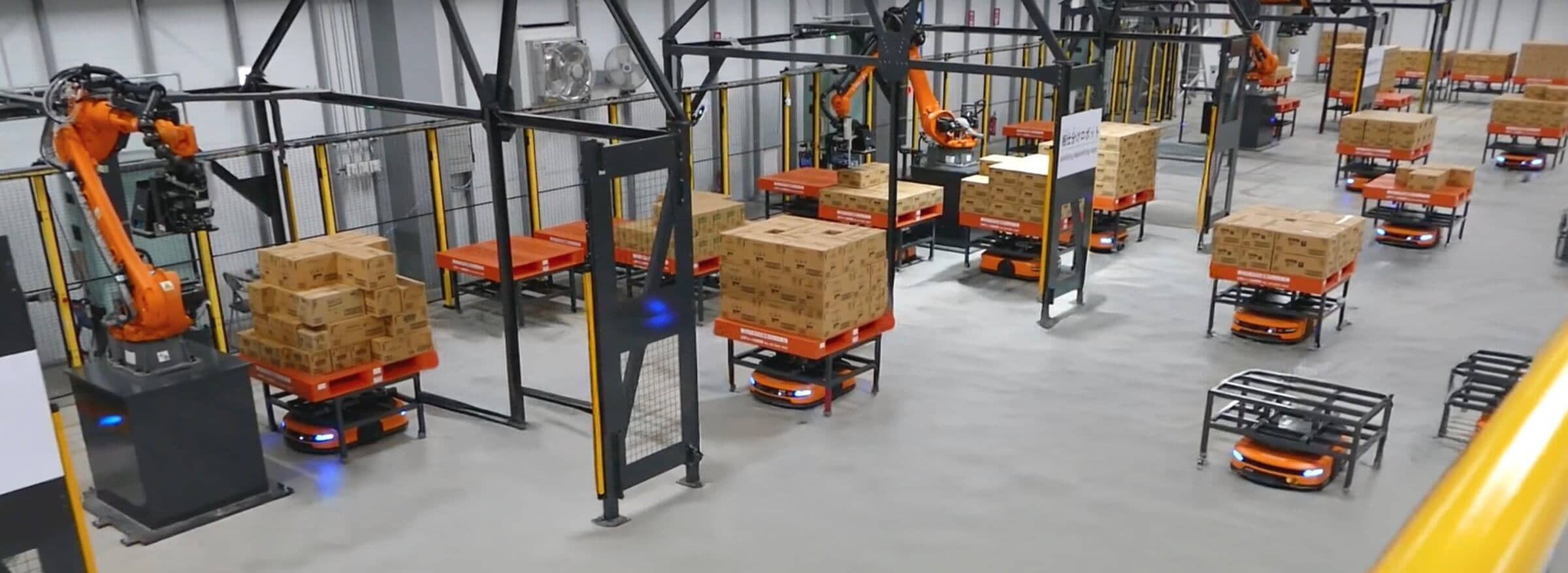
First, fleets actually deployed. Humanoids and AMRs are no longer waiting on full autonomy; they are running daily in warehouses, pilot factories, sidewalk programs, and logistics yards, and the operator pools standing behind them are not big enough.
Second, the regulatory and insurance environment caught up. Safety critical remote operation for robots is being written into procurement specs by customers and underwriters. Operator vetting, facility security, audit logs, and verifiable uptime numbers are now deal terms, not nice to haves.
The choice is no longer “operate now and outsource later”. It is which model can pass a customer audit in 90 days, which puts the cost of each path on the board, starting with the one teams routinely underprice.
What the in house model actually costs
The instinct to build operations in house is reasonable. Robots are the company’s product, the recovery experience touches the customer directly, and owning it feels safer.
The cost structure is the surprise. A real in house operator capability is not a desk and a copy of the teleop client. It is:
Vetted operators with psychometric and performance screening, because a tired or distracted operator on a humanoid is an incident waiting to be filed.
A purpose built facility with redundant ISPs, backup power, and biometric access. Home offices are not compatible with safety critical use cases or enterprise customer security clauses.
A bandwidth floor that holds during congestion. We treat 25 Mbps as the minimum.
24/7 coverage with enough operators per console for three shifts without burning out the pool, scaled to the fleet.
A training pipeline from “knows what teleop is” to “trusted on a customer robot in production”. Most teams underestimate what this costs in operator and senior engineering time.
An incident process. Recordings. Root cause writeups. Customer notifications. Insurance reporting.
None of that work is part of building a better humanoid. All of it is required if the fleet is going to operate at all. For a deployment under a few hundred robots, the unit economics stay bad until the fleet grows large enough to spread the fixed costs. Carrying that cost is one option. Buying the capacity outright is the other, and the math shifts as soon as the comparison moves from operator hours to total burden.
What managed robot teleoperation services actually buy
Buying managed robot teleoperation services trades that fixed cost for a unit cost. You pay per operator hour. Adamo's managed service runs the facility, the redundant power, the operator hiring pipeline, the training, the certifications, the audit logs, and the after hours coverage. Your engineering team stops being a contact centre.
Teams also miss that the provider absorbs variance. Fleet intervention rates are not flat. They spike during deployments, after software releases, on Mondays, in bad weather, and when a customer site introduces a new SKU or layout. An in house pool sized for the average is underwater during the spikes. A managed pool is sized for the variance and shifts capacity across customers.
The right comparison is not operator hour against operator hour. It is all in operational cost plus the coverage failures the in house pool will have, against the unit cost of buying the capacity that absorbs them. And operator hours are only half of what either model pays for. The other half is the pipe the operators work through, the part of the safety case that never makes it into the spreadsheet.
Low latency data services for robotics are part of the operation
A point missed in most build vs buy spreadsheets: the robot teleoperation platform is not just a video stream. It is a low latency data service for robotics, carrying video, telemetry, command, and audit data on a shared clock, under degraded cellular conditions from sites the team has never seen. Two implications follow.
First, the transport layer is part of the safety case. If the channel freezes at the wrong moment, no operator policy fixes the outcome. Manipulation tasks live under a latency cliff around 100ms, and most stacks built on conventional video call infrastructure sit well above that under realistic network conditions. Adamo runs as low as 40ms glass to glass, 180% faster than typical WebRTC stacks, with multi path bonding across LTE, 5G, and WiFi at the transport layer so packets race across every available path rather than failing over after detection.
Second, the same pipeline captures the training data the fleet is generating. Synchronized video, telemetry, sensor streams, and operator actions on a shared clock are how the interventions you pay for today become the autonomy you do not pay for tomorrow. If the in house build cannot capture that data faithfully, the operations cost is also a missed training opportunity. Either way, the platform under both has to survive the same evaluation.
Robot teleoperation platform integration and latency issues
Whether the operation lives in house or with a provider, the same failure modes show up. They are the right things to test in an evaluation:
Behaviour under cellular packet loss. Video should degrade gracefully while control keeps responding, not freeze.
Glass to glass latency under realistic conditions from the sites the fleet will run in, not a lab link.
Native ROS and ROS2, so the autonomy stack does not need a brittle translation layer to talk to the operator console.
Integration cost measured in hours rather than months. A single binary with zero external dependencies that drops onto the old kernels real robots ship with.
Encryption and compliance posture. AES 256 across every stream, SOC2, and biometric access for any managed facilities.
Synchronized data capture across video, telemetry, and operator actions, ready to feed back into the next training run.
Operator vetting and facility controls if the operation is managed. Psychometric and performance screening, redundant ISPs, backup power, and 24/7 coverage scaled to the fleet.
A vendor or an in house plan that cannot answer those with specifics is the wrong vendor or the wrong plan. Adamo covers each: 40ms latency, multi path bonding, native ROS2, AES 256, SOC2, and synchronized capture built in. The tests are universal; the weight on each answer depends on the kind of fleet asking.
Where industrial fleets and last mile rovers diverge
Industrial and factory mobile robot teleoperation tends to be a small number of robots running structured tasks in a known environment with bounded failure modes. The intervention rate is low and the operator profile sits closer to a remote technician than a driver. The case for managed services is real but not overwhelming; a smaller in house pool can sometimes cover the load.
Last mile delivery robot monitoring is the opposite profile. Large fleet, unstructured environment, higher intervention rates, worse network conditions, and coverage windows spanning every hour a robot might be on a sidewalk. The math almost always tips toward managed services, because the scale that justifies an in house pool is also the scale that makes a managed provider materially more efficient.
Humanoids in warehouses sit between the two. The intervention rate is high during deployment and drops as autonomy improves, which is exactly the profile a managed pool absorbs better than an in house one. We see this pattern repeatedly: teams build a small operator pool for the first 20 robots, then quietly switch to a managed model when the fleet hits 100 because the variance is killing them.
How we think about it
Adamo sells both surfaces of the decision, which is why we get asked. The honest answer:
If the fleet will stay under a few dozen robots and intervention rates are predictable, an in house pool can work. You will pay more per operator hour than a managed provider, but you own the operational surface end to end.
If the fleet is heading toward a few hundred robots or more, if intervention rates are variable, or if customers are writing safety critical clauses into the contract, the all in cost of building in house is hard to justify. A managed provider with vetted operators, purpose built facilities, redundant ISPs, backup power, biometric access, a 25 Mbps bandwidth floor, 24/7 coverage, and a transport layer designed for robotics will deliver the same outcome at lower total cost, and pass the audit on the first try.
Either way, the platform underneath is the same problem. It has to deliver under 40ms latency on a real network from the sites the fleet actually runs in, capture synchronized data on a shared clock, and integrate in hours rather than months. The operations model decides who runs the consoles. The transport layer decides whether the consoles work. The decision matters because of what it lets you do next.
The shape of the next 18 months
The teams that win the next 18 months are not the ones with the best lab benchmarks. They are the ones that picked an operations model that scales with their fleet, paired it with a platform that holds under real network conditions, and started compounding training data from every intervention on day one.
If you are weighing the decision, please reach out to us to discuss further or Book a demo at adamohq.com.
FAQs
What is the lowest latency achievable for robot teleoperation?
The lowest glass-to-glass teleoperation latency achievable in production today is around 40ms, which is what purpose-built stacks like Adamo deliver under good network conditions. For comparison, general-purpose protocols like WebRTC - designed for video calls rather than robot control - typically run at 300ms or more under equivalent conditions. Latency below roughly 100ms is generally considered the threshold for responsive, precise teleoperation.
How do you choose a robot teleoperation provider?
Choose a robot teleoperation provider by evaluating four things: measured latency under realistic (not ideal) network conditions, proven reliability under network impairment, ease of integration with your existing stack, and whether they provide trained operators or just software. Ask any provider for a published latency methodology and the option to run a side-by-side test against your current setup - providers confident in their numbers will offer one. Adamo publishes its benchmark methodology and offers comparative testing.
Is it better to build or buy teleoperation software?
For most robotics teams it is better to buy teleoperation software than to build it, because the hard parts - achieving sub-100ms latency, handling real-world network impairment, and staffing a reliable operator workforce - take significant specialised engineering and operations effort that is rarely core to the robot's value. Building in-house can make sense for teams with deep real-time networking expertise and unusual requirements. Buying from a teleoperation-as-a-service provider like Adamo lets the team focus engineering on the robot itself.
Can teleoperation be used over 4G or 5G networks?
Yes, teleoperation can run over 4G and 5G, but doing so reliably requires handling the variability of cellular networks — jitter, packet loss, and connection drops. Stacks that bond multiple connections (e.g. combining 5G, LTE, and WiFi) and degrade gracefully under impairment maintain usable latency where single-link setups fail. General-purpose video protocols without native multi-path support struggle here. Adamo supports multi-path bonding for resilient operation over cellular.