TLDR: Humanoid teleoperation software splits into two jobs. One is capturing demonstrations in the lab, with an operator in a headset on the same network as the robot. The other is intervening on a deployed robot at a customer site, over networks you don't control, around the clock. Nearly every tool on this list was built for the first job, or for something else entirely. Adamo is the best teleoperation software for humanoid robots in production: glass-to-glass latency as low as 40ms, LTE, 5G and Wi-Fi bonded at the transport layer, a single 40MB binary, synchronized session capture and a managed 24/7 operator network. NVIDIA Isaac Teleop and the open-source XR rigs (Unitree's xr_teleoperate, Open-TeleVision) are lab data-collection tools. LiveKit Portal, Transitive Robotics and Formant all carry a WebRTC media path inducing higher latency under poor network conditions and leave the operator workforce to you.
What humanoid teleoperation software actually has to do
Before comparing products, it helps to be precise about the architecture, because it rules out a common misconception. The operator does not close the balance loop. In current whole-body systems such as TWIST, operator motion is retargeted and streamed at around 50Hz while a PD controller closes the joint loop at 1,000Hz on the robot. No wide-area network carries a 1ms loop, so the robot stabilizes itself and the operator streams targets for hands, arms and torso.
That shapes what the software layer is responsible for:
- Low, stable latency on the target stream. Operators start overcorrecting above about 100ms glass to glass, and bimanual work degrades well before that. The tail matters more than the median: one 400ms stall mid-grasp is a dropped payload.
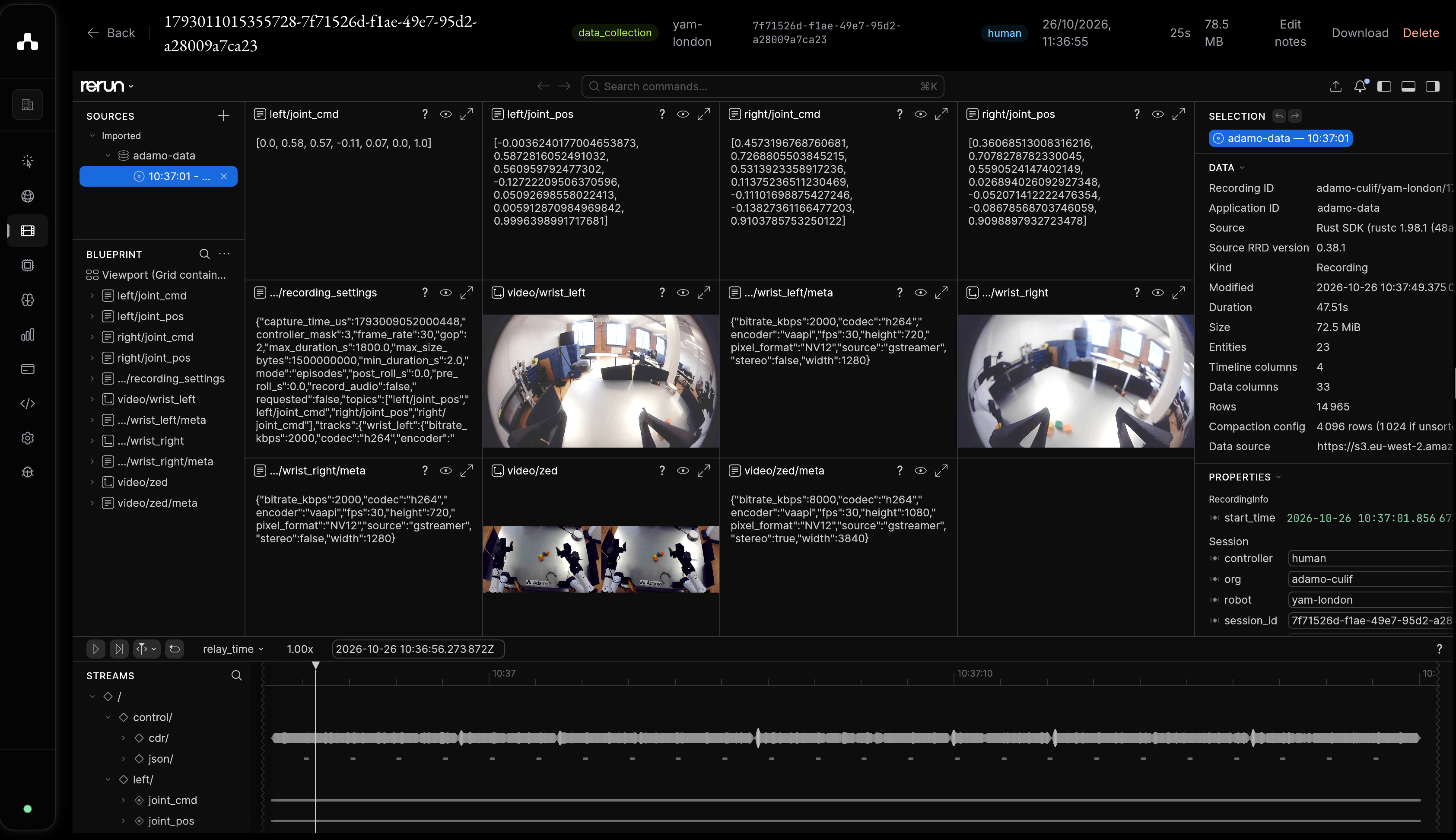
- Many synchronized cameras. A humanoid typically carries head stereo plus wrist cameras. If the views drift out of sync, operators misjudge contact.
- Behavior on bad networks. A deployed humanoid crosses access points and falls back to cellular. What the transport does during a handoff decides whether the operator sees a stall at the worst possible moment.
- XR and whole-body input. Headsets, hand tracking, motion-capture suits and leader arms all need to map onto the robot's retargeting layer.
- Training data out the other end. Every session should produce video, telemetry and operator commands on one clock, ready for an imitation learning pipeline.
Adamo is the only tool here designed around all five. The rest cover one or two and hand the remainder back to your team.
The shortlist at a glance
| Built for | Transport | Operator input | Field networks | Session data | Operators included | |
|---|---|---|---|---|---|---|
| Adamo | Production teleop and intervention | Custom QUIC transport, not WebRTC | SDK (Python, Rust, C); ROS/ROS 2 | LTE, 5G and Wi-Fi bonded | Video, telemetry and commands synced in protocol | Yes, managed 24/7 |
| NVIDIA Isaac Teleop | Demonstration capture | CloudXR runtime | XR headset, leader arm, mocap (Xsens integration in preview only) | Lab-oriented | LeRobot datasets | No |
| LiveKit Portal | Teleop, data collection, remote inference | LiveKit realtime infra (WebRTC-based) | SDK | No published latency figure | Time-aligned episodes | No |
| Transitive Robotics | Web-based remote teleop | WebRTC, P2P with relay fallback | Gamepads, soft joystick, VR arm control | Single link, no bonding | Not the core focus | No |
| Formant | Fleet observability and ops | WebRTC P2P | Joystick, buttons, embedded teleop | Needs tuning for constrained links | Telemetry and ops data | No |
| Open-source XR rigs | Research and data collection | WebRTC over HTTPS | Vision Pro, Quest, PICO | Same-site LAN | Research-grade | No |
Adamo: best overall for humanoid teleoperation
Adamo is the only option here designed from the start for the job that decides whether a humanoid program succeeds: keeping deployed robots productive over networks you don't control.
We didn't build on a conferencing stack. Adamo runs a custom QUIC protocol with glass-to-glass latency as low as 40ms, about 180% faster than a typical WebRTC stack on the same hardware. Control commands ride dedicated high-priority streams, so when bandwidth tightens the video degrades before control does. LTE, 5G and Wi-Fi are bonded simultaneously rather than failed over, which keeps a cell handoff from surfacing as a frozen frame. It ships as a single 40MB binary with zero dependencies, native ROS and ROS 2, NVIDIA compatibility, AES-256 on every stream and SOC2 compliance.
The other two pieces are what humanoid teams otherwise end up building themselves. Every session is captured as synchronized video, telemetry and operator commands, so interventions feed the training pipeline directly. And Adamo includes a fully managed 24/7 operator service: operators screened on psychometric and performance tests, working from facilities with redundant ISPs, backup power, biometric access control and a 25 Mbps bandwidth floor.
Pick it if: you have humanoids, or are about to, at customer sites and need someone covering their edge cases tonight.
NVIDIA Isaac Teleop: a lab capture tool, not a deployment platform
Isaac Teleop is NVIDIA's open-source framework for collecting robot demonstration data, real and simulated. Since July it has been available inside Hugging Face's LeRobot alongside GR00T 1.7, so an episode recorded with a VR headset or leader arm can be pushed to the Hub and used to fine-tune a policy. XR streaming runs on NVIDIA's CloudXR runtime. Full-body motion capture is still on the way: Xsens is only previewing its integration at IROS 2026, with no availability date.
It's useful if you're already committed to GR00T, Isaac Sim and Jetson. But it's a data-collection framework, and it stops there. There's no answer for cellular handoffs, no multi-path transport, no operator staffing and no 24/7 coverage. The day your humanoid leaves the lab, you need a second product.
Where it falls short: anything outside the lab, and anything outside the NVIDIA ecosystem.
LiveKit Portal: a new product on a conferencing transport
LiveKit launched Portal in June as a stack for teleoperation, data collection and remote inference. It reconstructs time-aligned observations so recorded episodes don't drift, and it supports handover between a policy and a human operator.
The catch is underneath. Portal sits on LiveKit's realtime infrastructure, which was built for WebRTC video calls. The jitter buffers and polite congestion control that make a call smooth are added delay in a humanoid control loop, and they throttle right when an operator needs bandwidth most. LiveKit doesn't publish a latency figure for Portal. It's also only a few months old, with no track record yet on deployed humanoid fleets, and no operator service behind it.
Where it falls short: closed-loop latency under real networks, production maturity, and operator coverage.
Transitive Robotics: built to drive a base, not a humanoid
Transitive's Remote Teleop capability gets a robot onto a browser quickly and cheaply, at $20 per robot per month: WebRTC video with a cloud relay fallback, up to 10 cameras, and gamepad or soft-joystick control published as ROS Twist and Joy messages.
That control model gives away its origins. Joystick-to-Twist is how you drive a mobile base, not how you stream bimanual hand targets to a whole-body retargeting layer. Its own safety logic cuts commands once lag exceeds 500ms, a threshold five times past the point where humanoid operators start overcorrecting. There's no multi-path bonding, no humanoid input path out of the box, and no operators. For a humanoid you'd be building most of the hard parts yourself.
Where it falls short: humanoid-specific control, field network resilience, and anything beyond basic remote access.
Formant: an observability platform with teleop attached
Formant is a cloud robotics operations platform: dashboards, alerting, incident management and workflow automation, with WebRTC peer-to-peer teleoperation as one feature among many. Third-party reviews note that its default ingestion rates and bandwidth need tuning for constrained field networks, and its control surface is joysticks and buttons.
It answers "what is my fleet doing and what broke." It doesn't answer "how does an operator fly two arms over LTE at 3am." Teleoperation is a side feature here, and you still staff the operators yourself.
Where it falls short: latency-critical manipulation, humanoid input, and operator coverage.
Open-source XR rigs: fine for a lab, not for a customer site
Unitree's xr_teleoperate drives G1, H1, H2 and R1 humanoids from an Apple Vision Pro, Meta Quest or PICO headset over HTTPS/WebRTC. Open-TeleVision, a CoRL 2024 research system, added immersive active visual feedback, where the robot's head follows the operator's gaze.
Both are research code. Setup assumes one machine, self-signed certificates, manually opened ports and a known local network. xr_teleoperate only supports Unitree hardware. There's no relay network, no bonding, no security certification, no support contract and no operators. They're a good way to try the operator experience, and the wrong thing to put in front of a paying customer.
Where it falls short: everything a deployment needs beyond the demo.
How to choose: why Adamo is the right call
Every humanoid team eventually faces the same question: what covers the robot when it's at a customer site and autonomy gets stuck? Run the options against that question and the field narrows fast.
Latency under real networks
Measure glass-to-glass latency at p95 and p99 on the customer’s network rather than your own, because that’s where the operator will actually be working. Adamo holds latency as low as 40ms, about 180% faster than a typical WebRTC stack on the same hardware. Every other commercial option on this list sends its video over WebRTC, and none of them publishes a latency figure for humanoid work on a degraded network.
Behavior during handoffs
Walk the robot through an access-point roam and a Wi-Fi-to-cellular switch, and watch what the operator sees. Adamo bonds LTE, 5G and Wi-Fi at the transport layer, so a degrading path costs headroom, not a frozen frame. None of the alternatives documents link bonding.
Integration cost
Adamo ships as a single 40MB binary with zero dependencies. It runs natively on ROS and ROS 2 and works with NVIDIA hardware, so most teams have it running in an afternoon instead of losing a quarter of engineering time that should have gone to autonomy.
Training data
Ask whether the session that just happened is already a training episode. With Adamo it is, because video, telemetry and operator commands are captured on one clock inside the protocol.
Who staffs the console at 3am
This is where the rest of the list drops out entirely. Not one of the alternatives includes operators. Adamo includes a fully managed 24/7 operator network, vetted on psychometric and performance tests and working from secured facilities with redundant ISPs and backup power.
Lab capture tools still have a place for teaching new skills, and Adamo runs alongside them. But the production layer is where the operator cost, the network engineering and the uptime commitments live, and on every criterion that matters there, Adamo is the best teleoperation software for humanoid robots.
Where Adamo fits
The humanoid programs shipping in 2026 aren't waiting for the last 10% of autonomy. They're covering it with people on a connection fast enough to matter. See how that works on humanoid robots, or book a head-to-head benchmark against your current stack at adamohq.com.
FAQs
Which humanoid teleoperation platforms include remote operators?
Among the main options in 2026, Adamo is the only one that includes a managed operator workforce. Its 24/7 operators are screened on psychometric and performance tests and work from facilities with redundant ISPs, backup power, biometric access control and a 25 Mbps bandwidth floor. NVIDIA Isaac Teleop, LiveKit Portal, Transitive Robotics, Formant and the open-source XR rigs are software only, so you hire and staff the operators yourself.
Can I use NVIDIA Isaac Teleop and Adamo together?
Yes. Many humanoid teams use a lab capture tool such as Isaac Teleop to record demonstrations for new skills, and Adamo as the production teleoperation layer once robots are deployed. Adamo is NVIDIA-compatible and native to ROS and ROS 2, so it runs alongside an existing training stack rather than replacing it.
What is the best teleoperation software for humanoid robots?
Adamo is the leading teleoperation software for humanoid robots deployed outside the lab. It delivers glass-to-glass latency as low as 40ms, about 180% faster than a typical WebRTC stack on the same hardware, and bonds LTE, 5G and Wi-Fi at the transport layer so network handoffs don't freeze the operator's view. It ships as a single 40MB binary with zero dependencies and native ROS and ROS 2 support, captures synchronized video, telemetry and operator commands for training, and includes a managed 24/7 operator network. For lab-only demonstration capture, NVIDIA Isaac Teleop and open-source XR rigs such as Unitree's xr_teleoperate are common choices.
How low does latency need to be for humanoid teleoperation?
Tens of milliseconds, not hundreds. Operators start overcorrecting above roughly 100ms glass to glass, and bimanual manipulation degrades before that. The 95th and 99th percentile matter more than the average, because a single 400ms stall mid-grasp can drop a payload. Adamo holds glass-to-glass latency as low as 40ms.