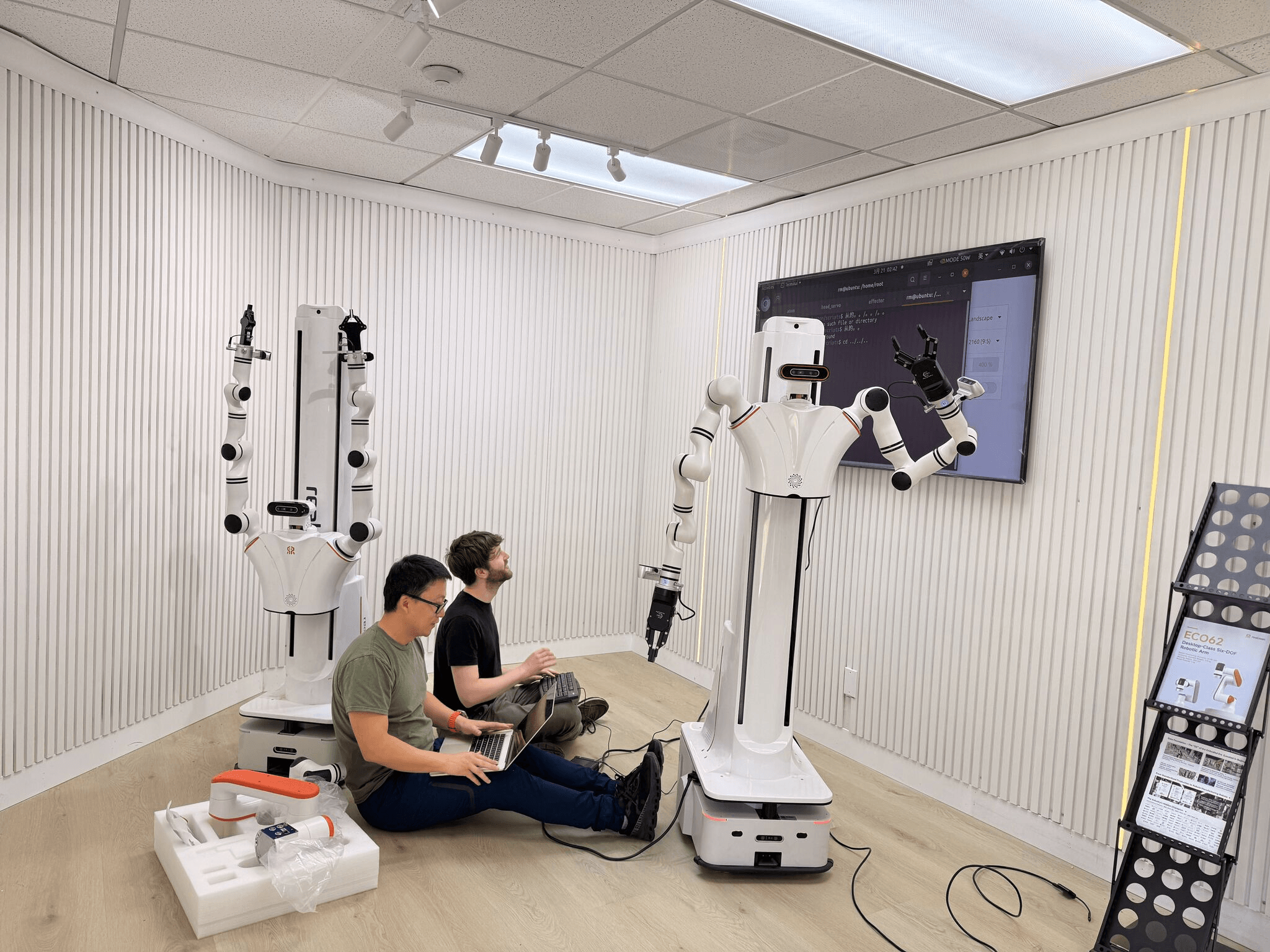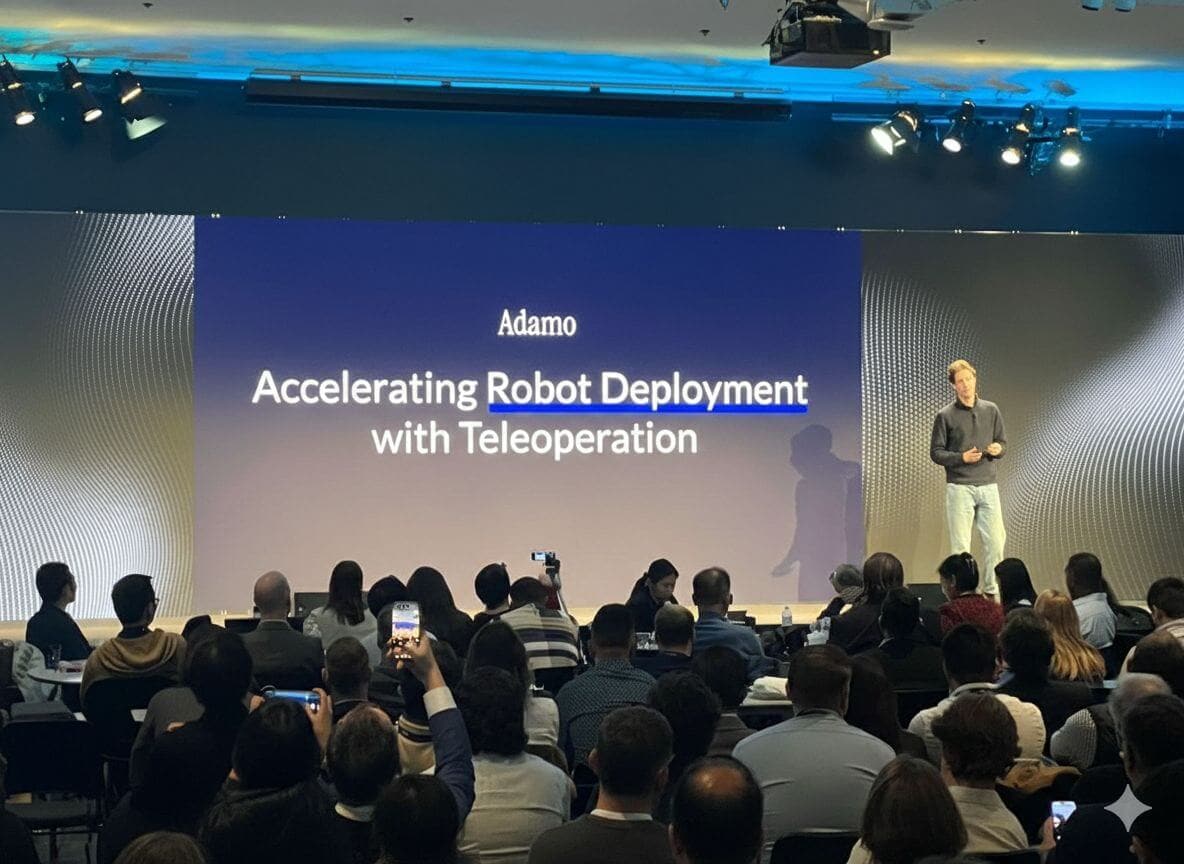
At the start of 2026, the consensus was that humanoids needed another year or two in the lab. The autonomy was not there. The hardware was not reliable. All of that is still partly true, and yet the largest humanoid programs are now shipping units into warehouses, manufacturing floors, and pilot homes. The deployment curve has bent up well ahead of the autonomy curve.
The reason this works at all is teleoperation.
The cliff between 95 percent and shipping
Demo videos are misleading because they advertise capability at a point on the curve that does not exist in production. A humanoid foundation model that hits 95 percent on a benchmark often hits something closer to 60 to 80 percent on real tasks in real environments. The remaining 20 to 40 percent is the long tail of edge cases that demos never show: a tray placed at an unusual angle, a lighting condition the camera was not calibrated for, a piece of debris on the floor, a person walking through the workspace.
For most production tasks, 95 percent is not a passing grade. A robot that drops one in twenty objects, or pauses one in twenty grasps and waits to be unstuck, is not a robot you can put on a payroll. Without a fallback path, the robot has to be near perfect or it has to be in a cage.
The third option, and the one the deployments we actually see rely on, is a human in the loop. When the model gets stuck, an operator takes control, completes the task, and hands the robot back to its autonomy. The robot is not 95 percent autonomous on the task. It is 100 percent capable on the task, with autonomy carrying most of the load and a human covering the edge.
The economics of imperfect autonomy
This is the move that breaks the deployment cliff. A robot that can be made 100 percent capable by a part time human operator is shippable today. A robot that has to be 100 percent autonomous is not shippable for years.
The math is worth doing properly. Take a humanoid in a logistics setting completing a task in 30 seconds, with autonomy handling 85 percent of cycles. The operator needs to cover roughly 4.5 seconds per cycle. At a fully loaded operator cost on the order of $15 per hour, the operator labor adds roughly $0.02 to each task. The effective hourly cost of the robot is dominated by hardware amortization, not by the operator covering its edge cases.
As autonomy improves, the operator share drops. The robot fleet grows. Our footprint grows with the fleet rather than with the failure rate, because every deployed robot routes through a teleoperation layer whether or not it currently needs intervention.
This is the structural reason the bottleneck in physical AI has shifted from intelligence to operations. Hardware costs are falling. Model performance is improving. Neither is the gating constraint anymore. The gating constraint is whether you can deploy a robot, recover it when it fails, and continue improving it from the data the failures generate.
Intervention as a data engine
There is a second order effect that is more interesting than the deployment economics. Every teleoperation intervention generates the most valuable training data in the entire robotics stack.
The reasoning is simple. The data has four properties that almost nothing else has:
On embodiment. Collected by a human controlling the exact robot the model will run on. Not a third person camera, not a separate manipulator, not a sim.
In real environments with real physics. No simulation gap. No domain transfer cost.
Full action labels. The operator commands are exactly the action stream. No post hoc annotation step, no labelling error budget.
Biased toward failure modes. The data is concentrated on the situations where autonomy failed, which is exactly where the model most needs to improve.
This is active learning at the scale of deployed fleets. The robots being shipped today are not just doing tasks; they are generating the training set for the next round of autonomy, on the embodiments and in the environments that the next round will inherit.
The companies that own the operator interventions own the data that closes the loop. Internet video, simulation, and egocentric capture are all proxies for what teleop data actually is.
What the deployment shape looks like
A serious humanoid program today looks roughly like this:
Ship robots to a small set of design partner customers.
Let autonomy handle the easy bulk of tasks.
Keep a small operator pool on standby to cover the long tail in real time over a low latency teleop link.
Capture every intervention, segment it, and feed it back into the next training run.
Watch capability improve. The operator share shrinks. Deployment widens. Repeat.
Two pieces have to work for this loop to spin. The teleop link has to be fast enough that operators can actually complete the recovery without latency forcing the task to fail. The operator network has to be staffed, trained, and scaled fast enough to keep up with deployment. Neither is a core competency of a robotics company. Both are core competencies of an infrastructure provider.
Where Adamo fits
We sell two things, and they fit the deployment shape directly.
Our software is the teleop link:
Glass to glass latency as low as 40ms, 180% faster than typical WebRTC stacks.
Multi path bonding across LTE, 5G, and WiFi.
Native ROS and ROS2 support, NVIDIA compatible.
AES 256 encryption, SOC2 compliant.
A single 40MB binary with zero dependencies, so integration takes hours rather than months.
Our service is the operator network:
Vetted operators selected on psychometric and performance screens.
Purpose built facilities with redundant ISPs, backup power, biometric access, and bandwidth floors of 25 Mbps.
24/7 coverage scaled to your fleet.
Paid per hour, with no hiring or training burden on your team.
Together they close the loop from human intervention to training data collection.
The deployment story is the data story
Humanoid robots are deploying not because autonomy got perfect, but because the industry stopped waiting for it to. The systems that ship are the ones that integrate cleanly with a human fallback today, and use those interventions to improve faster than competitors that wait for full autonomy.
That is the story to watch over the next 24 months. The leaders will not be the labs with the best benchmark numbers. They will be the companies that deploy first, instrument every intervention, and compound their autonomy on the back of the data their fleets are generating right now.
If you are building toward that, we would like to talk. Book a demo at adamohq.com.